
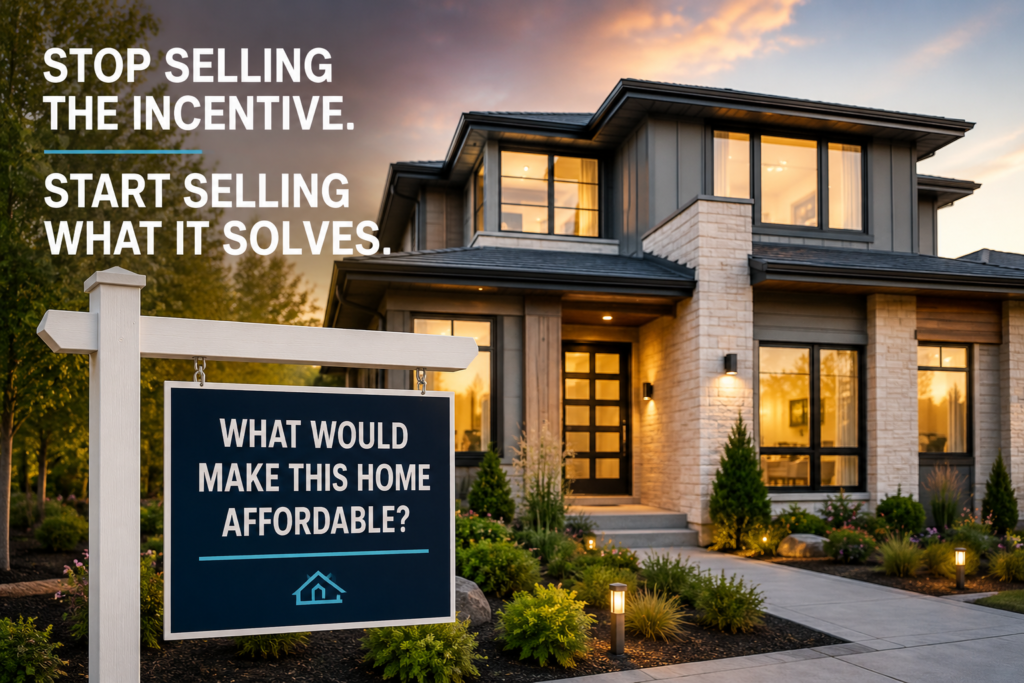
Home builders have an affordability problem. But most aren’t solving it simply by marking down their homes.
In August, 63% of builders reported using sales incentives, according to the National Association of Home Builders/Wells Fargo Housing Market Index. Just 35% reported cutting prices, with an average reduction of 6%.
That gap tells an interesting story about how builders are competing for today’s payment-sensitive buyer.
They’re buying down mortgage rates. Covering closing costs. Paying HOA dues. Offering flex cash and upgrades. And increasingly, they’re giving buyers more choice in how those incentive dollars are used.
Rather than simply reducing the price of the house, builders are finding ways to address the specific affordability issue keeping a buyer from saying yes.
So, what are builders offering right now? We took a look.
1. Mortgage Rates Are Becoming the Headline
With financing costs keeping many prospective buyers on the sidelines, some builders are making the mortgage payment the centerpiece of their promotions.
Meritage Homes, for example, is currently promoting monthly payments as low as $1,623 on select Austin-area homes, based on a 3.99% five-year fixed rate, along with up to $10,000 in closing costs.
There’s a reason for leading with the payment.
Buyers may have only a vague sense of what a $20,000 or $30,000 incentive means to them. A lower monthly payment is immediately understandable.
For builders, that suggests an important shift in messaging: Don’t just market the incentive. Show buyers what it does for their monthly payment.
2. Flex Cash Gives Buyers the Choice
One of the more interesting strategies we’re seeing is “flex cash,” an incentive pool that can be applied to different parts of the purchase.
Taylor Morrison has offered as much as $50,000 in flex cash on select homes. Depending on the promotion, buyers can apply those dollars toward options, lot premiums, temporary rate buydowns, discount points, closing costs, prepaid expenses or even HOA dues.
The appeal is obvious. The same incentive doesn’t solve every buyer’s problem.
One buyer may have plenty of cash but be struggling with the monthly payment. Another may qualify comfortably but balk at the amount of cash needed to close. A third may be reluctant to buy because the home doesn’t include the finishes or features they really want.
Flex cash lets buyers put the builder’s incentive where it has the greatest value to them.
3. Builders Are Looking Beyond Principal and Interest
Mortgage payments aren’t the only affordability concern.
Some builders are expanding incentives to address other costs of homeownership. Shea Homes, for example, is offering up to $10,000 toward eligible closing costs plus as much as $4,500 toward 12 months of HOA dues on select quick move-in homes in San Diego when buyers use its mortgage affiliate.
It’s a subtle but important change in perspective.
Instead of asking, “How much can we discount this house?” builders are asking, “What expense is keeping this buyer from saying yes?”
Sometimes it’s the mortgage payment. Sometimes it’s cash to close. Sometimes it’s the cumulative cost of owning the home during that first year.
4. Quick Move-Ins Are Getting the Sweetest Deals
Not surprisingly, many of the strongest incentives are being directed toward the homes builders most want to sell.
Completed and near-completed quick move-in homes frequently qualify for financing incentives, closing-cost assistance or other promotions that aren’t necessarily available throughout the community. Current offers from Meritage Homes and Shea Homes explicitly target select quick move-in inventory.
That’s smart inventory management.
Rather than resetting prices across an entire community, builders can concentrate incentive dollars on specific homes based on construction stage, inventory levels and sales velocity.
It also creates urgency. A special rate or incentive attached to a particular home, with a contract or closing deadline, gives buyers a reason to act rather than wait to see what mortgage rates or home prices do next.
5. The Mortgage Company Has Joined the Sales Strategy
There’s another common thread running through many of the most aggressive offers.
The best financing incentives frequently require buyers to use the builder’s affiliated or preferred lender.
That gives large builders with mortgage operations another competitive tool. They can combine home pricing, seller credits and financing incentives to create an overall affordability package that may be difficult for smaller competitors to match dollar-for-dollar.
But regional and smaller builders don’t necessarily need to match a national builder’s incentive budget.
The lesson is to identify the buyer’s biggest obstacle first, then work closely with preferred lenders to determine how available incentive dollars can have the greatest impact. A well-structured $15,000 incentive may be more persuasive than a poorly communicated $25,000 one.
6. Some Incentives Target the Buyer, Not the House
Not every incentive needs to apply to everyone.
Century Communities, for example, currently offers up to $1,500 toward closing costs through its Hometown Heroes program for qualifying law enforcement officers, first responders, teachers, nurses and active or retired military buyers who finance with its affiliated lender.
Programs like these accomplish something a blanket discount doesn’t. They give builders a reason to communicate directly with a specific audience while creating a positive marketing story around the incentive.
Depending on the community, similar thinking could be applied to first-time buyers, move-down buyers, local employees or other groups important to a particular market.
Which Affordability Problem Are You Trying to Solve?
That’s ultimately the question builders should be asking before deciding how to spend incentive dollars.
If the buyer’s obstacle is the monthly payment, a mortgage-rate buydown may deliver more perceived value than a price reduction.
If the buyer’s obstacle is the cash to close, closing-cost assistance may be more persuasive.
If buyers are worried about first-year expenses, HOA or prepaid-cost assistance could help.
If buyers love the community but aren’t satisfied with what their budget buys inside the home, design or upgrade credits may close the gap.
If different buyers have different objections, flex cash gives them choices.
And if the problem is standing inventory, attaching the strongest incentives to specific quick move-in homes can create urgency without discounting an entire community.
Make the Value Tangible
There’s an important marketing lesson in all of this.
“$25,000 buyer incentive” sounds generous. But it still requires buyers to figure out what $25,000 actually means to them.
A lower monthly payment is tangible.
Less cash needed at closing is tangible.
A year of HOA assistance is tangible.
The kitchen upgrades a buyer thought were out of reach are tangible.
Today’s strongest builder promotions aren’t simply offering buyers money. They’re translating those dollars into solutions for the financial issues preventing buyers from purchasing a home.
And in a market where nearly two-thirds of builders are offering some form of sales incentive, simply having an incentive may no longer be enough. NAHB’s August 2026 data
The competitive advantage comes from offering the right incentive to the right buyer on the right home.